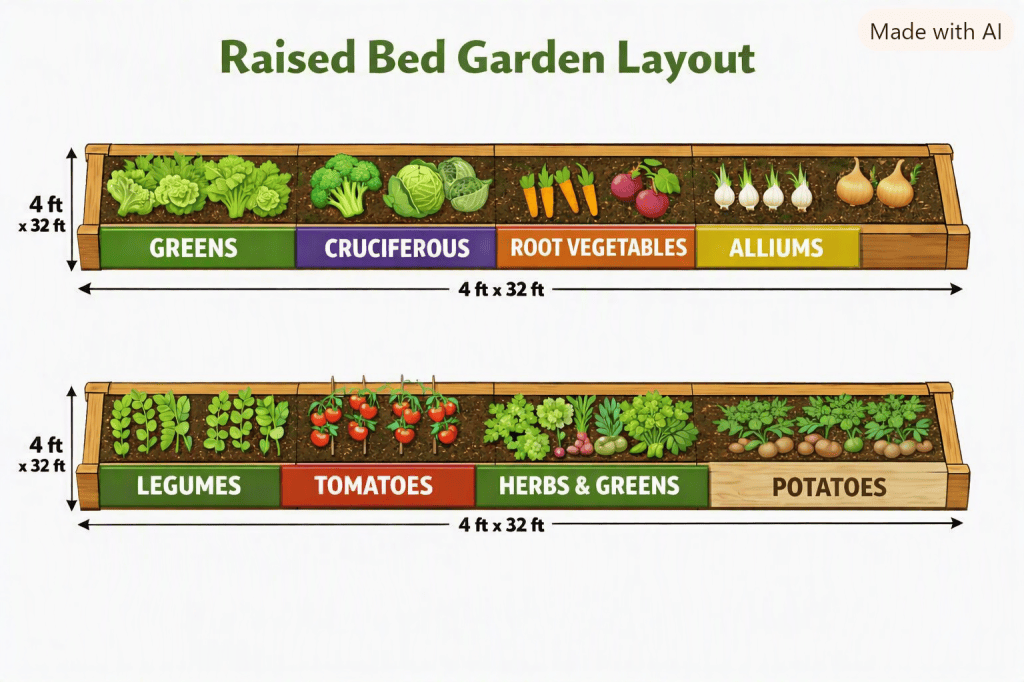
I finally finished mapping out my entire garden using the Square Foot Gardening method, and I’m really happy with how everything fits together. I’ve got two long raised beds, each divided into four 4’×8′ sections, so I label them A1–A4 and B1–B4. Each section is 32 square feet, which gives me 32 squares to work with.
I’m growing for year‑round harvests, Daily Dozen nutrition.
Here’s how I’m setting it all up.
🌿 BED A — Greens & Crucifer Powerhouse
A1 — Lettuce & Spinach (32 squares)
This is my salad bed.
- 16 squares of lettuce (16 plants per square)
- 16 squares of spinach (16 plants per square)
This bed produces fresh greens almost all year, especially with my mild winters and quick‑melting snow.
A2 — Kale & Swiss Chard (32 squares)
My winter workhorse bed.
- 16 squares kale (4 plants per square)
- 16 squares chard (4 plants per square)
Both of these should overwinter beautifully here.
A3 — Cabbage (32 squares)
- 32 squares, 1 cabbage per square Spring heads, fall heads, and some overwintering.
A4 — Broccoli (32 squares)
- 32 squares, 1 broccoli per square Spring heads, fall heads, and winter side shoots.
🥕 BED B — Roots, Storage Crops, Winter Crops & Tomatoes
B1 — Potatoes (32 squares)
My potato bed B1 — Potatoes (32 squares). This is my potato section.
- 32 squares, 2 potatoes per square → 64 plants total
This spacing gives me medium‑sized potatoes, which is exactly what I use most often. I should get 60–90 lbs. of potatoes.
B2 — Onions & Garlic (32 squares)
- 16 squares onions (16 per square)
- 16 squares garlic (9 per square)
These are my storage crops for the year.
B3 — Brussels Sprouts (32 squares)
- 32 squares, 1 plant per square This is my winter harvest bed — sprouts love my climate.
B4 — Indeterminate Paste Tomatoes (32 squares)
- 8 squares tomatoes (1 per square)
- 24 squares basil, marigolds, and lettuce as companions
This gives me 150–250 lbs. of paste tomatoes for sauce, soup base, and canning. I want to be able to eat some fresh as well. Providing they do well in just 4 hours of direct sun, they may not.
📅 My Month‑by‑Month Planting Calendar (Zone 8b, Square Foot Method)
JANUARY
Harvest kale, spinach, chard, Brussels sprouts. Greenhouse lettuce and spinach keep me going.
FEBRUARY
Start cabbage, broccoli, and onions indoors. Direct sow spinach and peas.
MARCH
Start tomatoes indoors. Transplant cabbage and broccoli into A3 and A4. Direct sow lettuce, spinach, carrots, beets, turnips. Plant onion sets.
APRIL
Transplant kale and chard into A2. Direct sow beans. Plant potatoes in B1.
MAY
Transplant tomatoes into B4. Direct sow more lettuce and spinach.
JUNE
Succession sow greens. Harvest peas and early roots.
JULY
Direct sow fall broccoli, cabbage, kale, carrots, beets, turnips.
AUGUST
Transplant fall brassicas. Direct sow fall greens. Harvest tomatoes and potatoes.
SEPTEMBER
Direct sow spinach and lettuce. Plant garlic and overwintering onions in B2. Cover crop any empty squares.
OCTOBER
Main garlic planting window. Mulch everything. Harvest Brussels sprouts.
NOVEMBER
Harvest fall roots, cabbage, broccoli. Mulch beds for winter.
DECEMBER
Harvest kale, spinach, chard, greenhouse lettuce. Rest month.
❄️ My Overwintering Plan
Outdoors:
- Kale
- Chard
- Spinach
- Cabbage
- Broccoli
- Brussels sprouts
- Garlic
- Onions
Greenhouse:
- Lettuce
- Spinach
My winters are mild enough that snow melts in a day or two, so overwintering is easy here.
🌻 Why This Layout Works for Me
- It covers all my Daily Dozen fresh vegetables.
- It gives me year‑round harvests.
- It fits my shade‑heavy mountain climate.
- It uses Square Foot Gardening spacing (1‑4‑9‑16).
- It keeps potatoes, tomatoes, brassicas, and onions in proper rotation.
- It’s simple, repeatable, and easy to manage.
This is the plan I’ll be using going forward — A1 through A4 and B1 through B4 — and it finally feels like everything fits together the way it should.
🛒 What I Still Have to Buy Each Year to Meet My Daily Dozen
Even with everything I’m growing in my A1–A4 and B1–B4 beds—plus my berries, grapes, apples, and pears—there are still a few Daily Dozen categories I can’t grow here. This is what I still need to buy each year, using my serving sizes and assuming full fruit production.
🫘 Dry beans — 3 servings per day (½ cup cooked each)
- 3 servings/day = 1.5 cups cooked/day
- Dry beans double when cooked → 1.5 cups cooked = ¾ cup dry/day
- ¾ cup dry × 365 ≈ 274 cups dry/year
- 1 cup dry ≈ ½ lb
✔ I need about 135–140 lbs of dry beans per year.
🌾 Whole grains — oats mostly (3 servings per day, ½ cup cooked each)
- 3 servings/day = 1.5 cups cooked/day
- Oats triple when cooked → 1.5 cups cooked = ½ cup dry/day
- ½ cup dry × 365 ≈ 182.5 cups dry/year
- 1 cup dry ≈ ½ lb
✔ I need about 90–95 lbs of oats per year.
🌰 Nuts — 1 serving per day (¼ cup)
✔ I need about 20–30 lbs of nuts per year.
🥄 Flaxseed — 1 tablespoon per day (ground)
✔ I need about 5–10 lbs of flaxseed per year.
🍎 Other fruit — 3 servings per day (apples, pears, grapes, berries)
With:
- full production from apples, pears, grapes, and
- extra berries counted toward “other fruit,”
my homestead can cover my 3 servings of fruit per day.
✔ I don’t need to buy other fruit in a normal year. Maybe a small buffer of 0–10 bananas per month in a weak harvest year, but most years: no purchased fruit.
🍓 Berries — 1 serving per day
I grow all my berries myself:
- Strawberries
- Blueberries
- Currants
✔ No berries needed from the store.
🌻 Final summary
What I still have to buy each year to meet my Daily Dozen:
- ✔ Dry beans: 135–140 lbs
- ✔ Oats: 90–95 lbs
- ✔ Nuts: 20–30 lbs
- ✔ Flaxseed: 5–10 lbs
- ✔ Fruit: none in a good year (maybe a few bananas as backup)
Everything else—greens, vegetables, potatoes, onions, garlic, tomatoes, berries, apples, pears, grapes—I grow myself.
And yes — this is theory
I will have to see how it goes and hopefully I can reach my goal without buying any extras most years, especially once everything is in full production. We (Copilot and I) left out the dwarf peach tree in our computation… but no matter, it still works theoretically.
Fruit systems take time to mature, and real harvests wiggle around year to year. I’ll learn my land’s rhythm as I go.
But the theoretical model is sound, even with the dwarf peach not being added. I still plan on the peach tree though!
Just sharing the sample plan again!