These days I’m spending less time thinking about what I can make work here and more time planning where I want to be a few years from now. As I look ahead, a small, productive homestead on a city lot is becoming clearer in my mind.
One decision I’ve recently made is that I’m no longer going to try to grow vegetables in my current yard here in Northern California. The amount of garden space and shade on this property makes vegetable gardening a battle and trade off for what I really want, and I’ve finally accepted that my time and energy are better spent elsewhere.
Instead, I’ve decided to focus on improving and maintaining this property so it will be ready to sell around 2029. Every improvement I make now will help simplify that future transition.
At the same time, I’ve continued refining my vision for a smaller, more manageable homestead. Rather than a large rural acreage, I’m increasingly attracted to the idea of a small city lot where I can build a modest 16′ x 40′ home that meets my needs without giving me more maintenance than I can handle.
The garden plans haven’t disappeared. In fact, they’ve become more focused.
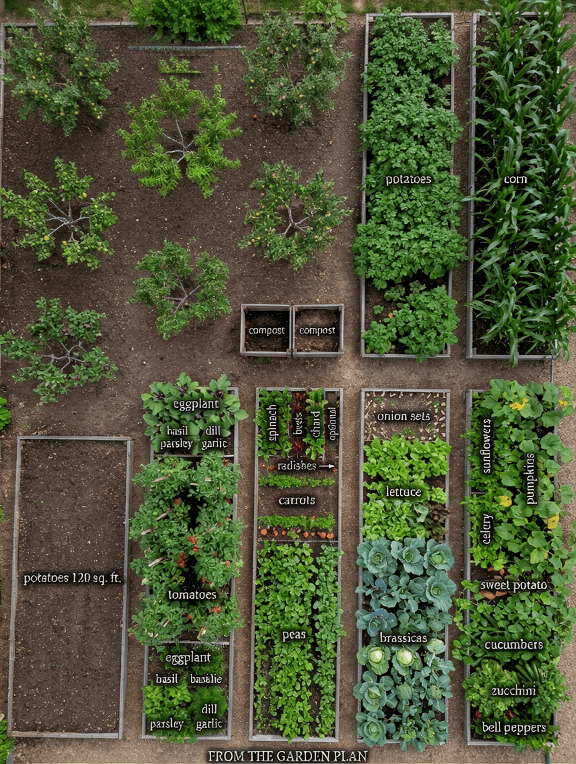
My current vision includes seven 4′ x 25′ garden beds laid out using many of the ideas from John Jeavons’ biointensive growing methods and the spacing of the square foot garden method. The garden would supply a large portion of the fresh vegetables, fruits, and legumes that support a healthy whole-food, plant-based diet.
Alongside the garden beds would be a small orchard consisting of five dwarf fruit trees and two hazelnut trees. Dwarf trees appeal to me because they’re easier to care for, easier to harvest, and much better suited to a small property.
One advantage of a city lot is that fences become productive space. Grapes can be trained along sunny fence lines, and berry bushes can be planted around the perimeter. Blueberries, black currants, raspberries, and even lingonberries could provide a surprising amount of food in a relatively small area.
Another reason my thinking has changed is transportation. Right now, a trip to town involves about an hour of driving and with gas prices as they are, that is not sustainable. At 73, I can see the value in having grocery stores, medical care, pharmacies, libraries, and other services much closer.
Being closer to people also has advantages. Help is nearby when needed. As we age, convenience can be just as important as independence.
One of the lessons I’ve learned is that downsizing doesn’t necessarily mean giving something up. Sometimes it means choosing what matters most. A smaller property can mean less mowing, less maintenance, less expense, and more time for gardening and enjoying life.
The goal is to create a place that supports the life I want to live. For me, that vision increasingly looks like a small home, a productive garden, a few fruit and nut trees, berry bushes along the fence, and a community close enough that I don’t need to spend hours on the road every week.
The path forward begins by letting go of plans that no longer fit and putting energy into the ones that do.
This is an AI rendering of John Jeavens FOUR PERSON FAMILY FOOD GARDEN, 6-MOUTH GROWING SEASON. I have made it for a ONE PERSON DAILY DOZEN GARDEN (SQUARE FOOT GARDENING), although I don’t have a rendering for that. With my garden beds all 4’x25′ the whole space is about 34’x30′ which shouldn’t have a problem fitting in a smaller back yard, but, is more space than my current yard can handle. This is what I want.